How to Host a Friendsgiving: A Stress-Free Potluck Plan (Timeline, Sign-Up List, and Menu Math)
Friendsgiving has all the warmth of Thanksgiving with fewer of the rules. There's no great-aunt's stuffing you have to recreate and no assigned seat you've had since 1998. It's just people you like, a lot of food, and a long, slow evening around a table.
The flip side is that someone has to organize it. Without a plan, a potluck can end with four bags of rolls, no gravy, and a turkey still raw at 7 p.m. This guide is the logistics half of hosting: when to throw it, what you cover versus what guests bring, a sign-up list by category, how much food you really need, and how to handle the oven, allergies, and leftovers before they turn into problems.
If you're still sorting out what to say in the invite itself, our Thanksgiving invitation wording guide has dozens of examples. When you're ready to send, browse Friendsgiving invitations on Rizz Invites and collect RSVPs in one place.
When to Host Friendsgiving (and When to Send the Invite)
Before or after Thanksgiving? Most Friendsgivings happen the weekend before Thanksgiving, which in 2026 is Saturday, November 21 or Sunday, November 22. Everyone is still in town, nobody is tired of turkey yet, and it doesn't clash with family plans.
Other options that work:
- The Tuesday or Wednesday of Thanksgiving week. Great for coworkers or friends who travel later in the week, but expect a smaller crowd.
- The Friday or Saturday after Thanksgiving. A "leftovers Friendsgiving" is relaxed and cheap, since half the dishes are already made. It's ideal for people who stay local.
- Early November. If your friends are spread across busy schedules, getting in early beats competing with every other holiday party.
When to send the invite: Three to four weeks ahead is the sweet spot. That gives guests time to block the date and gives you time to fill the sign-up list. For a weekend-before party, that means sending invites by the end of October or the first few days of November. If you're late, two weeks still works for a casual group. Just ask for RSVPs within a few days so you can plan food.
Set an RSVP deadline about 7 to 10 days before the party. That's when you'll need a headcount to buy the turkey and check that every category on the sign-up is covered.
Hosted, Potluck, or Hybrid: Decide What You're Providing
Before anyone signs up for anything, decide what kind of Friendsgiving you're throwing. Saying so clearly up front prevents most of the awkwardness later.
Fully hosted. You cook everything, and guests bring only themselves (and maybe a bottle). This is generous and keeps the menu cohesive, but it's a lot of work and expense. It works best for small groups of six to eight.
Full potluck. Every guest brings a dish, including the main. It's the cheapest option and spreads the work, but the risk is a lopsided table. It works best with a sign-up list and a group of reliable cooks.
Hybrid (the most popular). The host provides the turkey or main protein, gravy, plates, and the space. Guests bring sides, desserts, and drinks. This is the classic Friendsgiving potluck setup, and it's the one we'd recommend for most groups.
A good rule for hybrids: the host covers anything that needs your oven for hours, and anything everyone depends on. That means the turkey, gravy, and usually a basic starch like mashed potatoes or rolls, plus ice, plates, cups, napkins, and trash bags. Guests cover everything that travels well.
Whatever you choose, say it in the invitation. Here's the one short wording sample in this guide, and it covers the essentials:
Friendsgiving at Maya's! 🦃
Saturday, Nov 21 · 5 p.m.
I've got the turkey, gravy, and drinks. Please grab a side, dessert, or something to sip on the sign-up list.
RSVP by Nov 12 so I know how big a bird to buy.
Build a Potluck Sign-Up by Category (Mains, Sides, Desserts, Drinks, Supplies)
The fastest way to avoid three mac and cheeses is to split the menu into categories with a set number of slots. Guests pick a slot rather than a vague "bring something."
Here's a sign-up template for about 12 guests with a host-provided turkey:
Mains (host + 1 guest)
- Turkey (host)
- Second protein or vegetarian main, such as ham, a lasagna, or a stuffed squash (1 guest)
Sides (5 guests)
- Stuffing or dressing
- Mashed potatoes or sweet potatoes
- Green vegetable (green beans, Brussels sprouts, roasted broccoli)
- Mac and cheese or another baked casserole
- Salad or something fresh and crunchy
Bread and extras (1 guest)
- Rolls and butter, plus cranberry sauce
Desserts (2 guests)
- Pie (pumpkin, pecan, or apple)
- One non-pie dessert, such as brownies, a cake, or cookies
Drinks (2 guests)
- Wine, cider, or beer
- A non-alcoholic option: sparkling water, punch, or mocktail mix
Supplies (1 guest)
- Ice, foil, to-go containers, and extra napkins
A few tips make the list work:
- Name the slot, not the recipe. "Green vegetable" leaves room for creativity without duplication.
- Ask people to add what they're making so others can see it, and so you can spot allergens.
- Give your non-cooks real jobs. Drinks, ice, supplies, and store-bought dessert are all valuable. Nobody should feel bad for not baking.
- Leave one or two "wild card" slots for the friend who insists on bringing their famous dip.
You can share the sign-up as a link in your digital invite or a shared note. If you're inviting a bigger crowd or mixing friend groups, a simple RSVP page saves a lot of group-chat scrolling. Our dinner party invitation templates work well for smaller, sit-down versions of Friendsgiving too.
How Much Food for 8, 12, or 20 Guests
Menu math is where first-time hosts panic. Here's a simple guide. These amounts assume a hybrid potluck with plenty of sides, and they leave room for modest leftovers.
Turkey per person: Plan on about 1 to 1.5 pounds of whole turkey per guest (the bones account for a lot of the weight). Use 1.5 pounds if you want leftovers. If you're serving a boneless turkey breast, half a pound per person is enough.
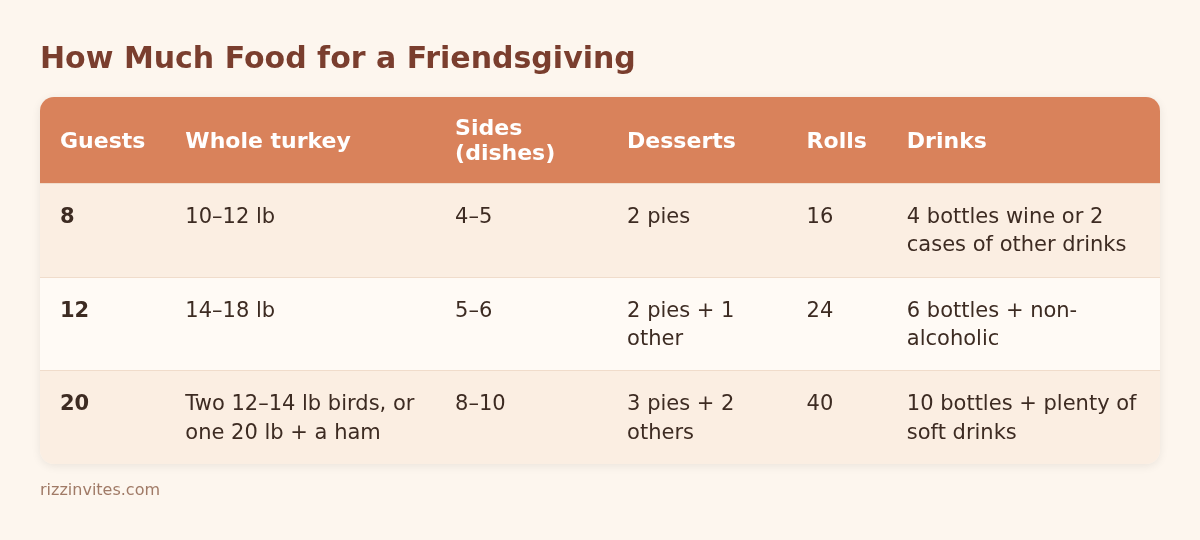
Side dish sizes: One standard 9x13 casserole feeds about 10 to 12 people as a side when there are several other sides. Ask guests to bring dishes sized for the whole party rather than "enough for me and a bit."
Pies: One pie cuts into 8 slices, but at a big spread people often take a sliver of two kinds. Plan on one pie per 6 to 8 guests.
Ice: About one pound per guest, more if drinks are in a cooler.
For 20 or more, two smaller turkeys cook faster and more evenly than one giant bird. Better yet, ask a friend to roast the second one at their place and bring it carved.
Thawing reminder: A frozen turkey needs about 24 hours in the fridge for every 4 to 5 pounds. A 16-pound bird needs to start thawing about four days before the party. Write it on your calendar now.
Solve the Oven, Allergy, and Serving-Spoon Problems Ahead of Time
Most Friendsgiving chaos comes from three predictable problems. Solve them in the planning stage and the party runs itself.
The oven problem. Your turkey will occupy the oven for hours, and then eight guests arrive needing to "just warm this up for 20 minutes." Head it off:
- Ask guests to arrive with dishes hot and ready, wrapped in foil and towels, or in an insulated carrier.
- Line up alternate heat sources: slow cookers for mashed potatoes and stuffing, a toaster oven, an air fryer, or a warming tray.
- Let the turkey rest. A turkey should rest 30 to 45 minutes after it comes out, which frees the oven for a quick round of reheating at 350°F.
- Make room-temperature dishes part of the plan. Salads, cranberry sauce, rolls, and most desserts don't need heat at all.
The allergy problem. Ask about dietary needs in your RSVP form, and pass the answers along to everyone cooking. Then:
- Ask each cook to label their dish with its name and major allergens (nuts, dairy, gluten, shellfish). A folded index card works fine.
- Make sure at least one main and two sides suit vegetarians or anyone gluten-free, if you have them coming.
- Keep nut desserts on a separate plate with their own server.
The serving-spoon problem. Every potluck runs out of spoons. Ask guests to bring their dish with its own serving utensil, and keep a backup stash of tongs, ladles, and big spoons. Put a piece of masking tape with the owner's name on dishes and utensils so they go home with the right person.
Bonus: the space problem. Clear counter space for a buffet line before guests arrive, and put drinks somewhere separate so people don't bottleneck at the food.
Friendsgiving Activities That Aren't Awkward
You don't need a schedule, but a couple of low-pressure activities help mixed groups warm up, especially while the turkey rests.
- A gratitude jar. Leave slips of paper by the door. Guests write something they're thankful for, and someone reads a few anonymously at dessert. It's touching without putting anyone on the spot.
- Pie ranking. Everyone tastes the desserts and votes. It's silly, competitive, and perfect for a potluck.
- Classic games. Charades, Heads Up, Codenames, or a Thanksgiving trivia round all work for groups from 6 to 20.
- Football, if your crowd likes it. Have a game on in another room for anyone who wants it, rather than making it the centerpiece.
- A "recipe card" swap. Ask cooks to bring a card with their recipe. Guests take home the ones they loved.
- A group photo before you eat. Once the food is gone, so is the nice lighting and everyone's patience.
Skip anything that requires people to perform or share something very personal. The best Friendsgiving activities are easy to opt out of.
Leftovers, Cleanup, and the Thank-You Text
Leftovers etiquette. The general rule: guests can take home leftovers of the dish they brought, and the host decides what happens with everything else. Most hosts happily share. Make it easy:
- Have to-go containers or zip bags ready (or put them on the supplies slot of your sign-up).
- Offer leftovers to guests who live alone or traveled far, first.
- Refrigerate food within two hours of serving. Turkey is good in the fridge for three to four days.
Cleanup. Ask two or three friends ahead of time to stay for 20 minutes of cleanup. Run the dishwasher before the party so it's empty, set out a trash bag and a recycling bag in plain sight, and return everyone's dishes before they leave. Washed is ideal, but rinsed is fine.
The thank-you text. Send a quick group message the next day. Thank people for coming, give a shout-out to the pie-ranking winner, share the group photo, and mention any dishes left behind. It closes the evening warmly and makes everyone want to come back next year.
Frequently Asked Questions
Is Friendsgiving before or after Thanksgiving? Usually before, most often the weekend before Thanksgiving. Some groups host the Friday or Saturday after instead and build the menu around leftovers.
When should I send Friendsgiving invitations? Three to four weeks ahead, with an RSVP deadline about 7 to 10 days before the party. Two weeks is fine for a casual group.
What does the host provide at a Friendsgiving potluck? In a hybrid potluck, the host usually provides the turkey or main, gravy, plates, cups, napkins, ice, and the space. Guests bring sides, desserts, and drinks.
How much turkey do I need per person? About 1 to 1.5 pounds of whole turkey per guest, or half a pound of boneless turkey breast.
How do I stop everyone from bringing the same dish? Use a sign-up list with categories and a set number of slots, and ask guests to write what they're bringing.
Is it rude to ask Friendsgiving guests to bring a dish? Not at all. Potluck is the tradition for Friendsgiving. Just say so clearly in the invitation and make sure non-cooks have options like drinks or supplies.
Can I send Friendsgiving invitations for free? Yes. Rizz Invites is free for up to 10 guests. For bigger gatherings, one-time upgrades cover up to 50 guests (Pro, $14.99), 150 guests (Premium, $29.99), or 1,000 guests (Elite, $64.99), with no subscription.
Ready to get the group together? Pick one of our Friendsgiving invitations, or if family is joining too, browse our Thanksgiving dinner invitations.